Oakbrook Commerce

What should you know before importing hardware?

Three short guides for cabinet shops, remodelers and hardware retailers buying from factories in China, Vietnam and Taiwan for the first time.

What belongs on a hardware spec sheet before you ask for quotes?
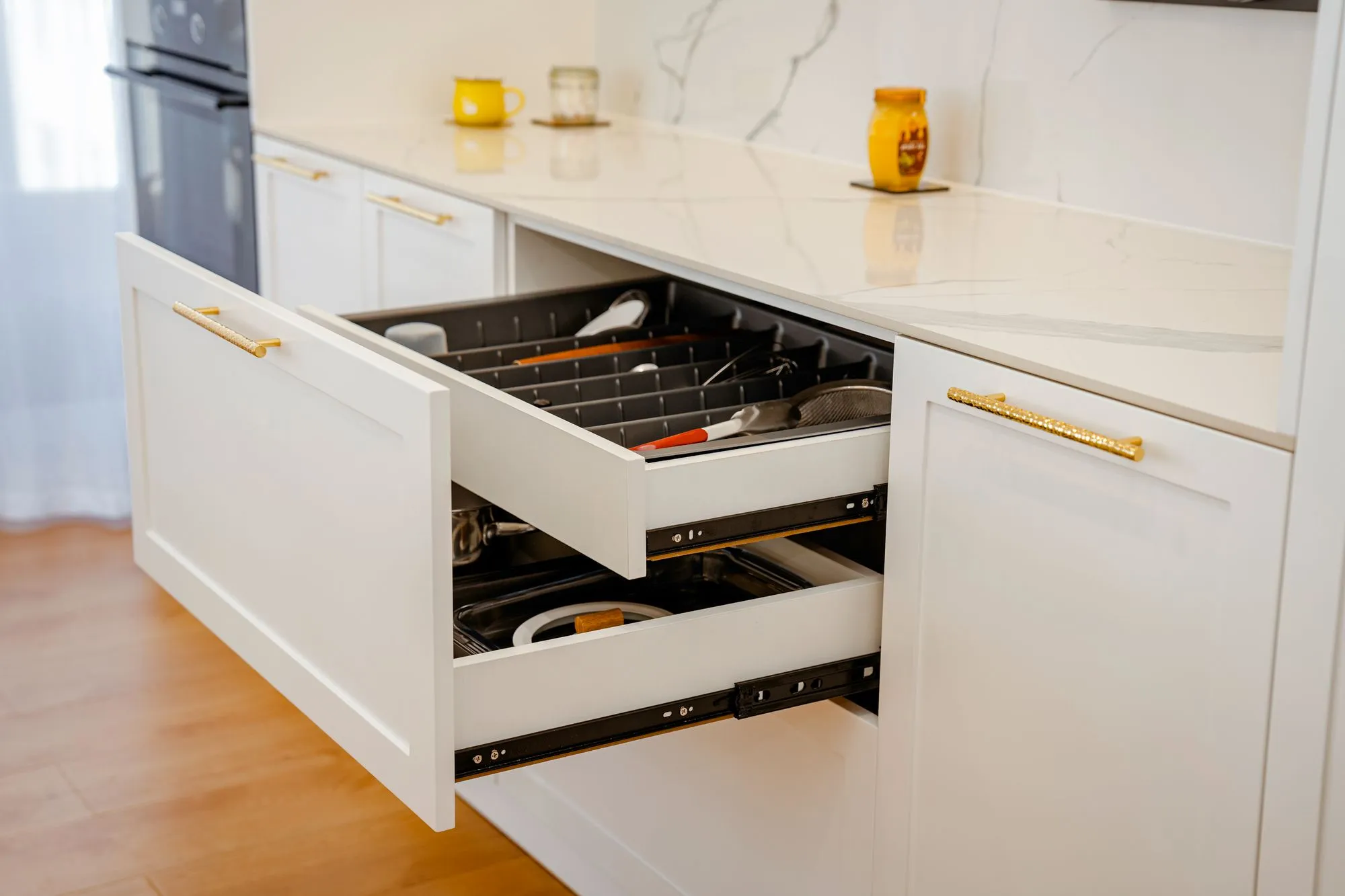
Open white kitchen drawer holding utensils above a marble counter

Enough detail that two factories quote the same part. If one factory prices a zinc-alloy pull and another prices stainless steel, the cheaper quote is not cheaper. It is a different product.

Pulls and knobs. Give the hole spacing center to center in millimeters (96, 128 and 160 mm are common), overall length, projection from the door, base material and finish name with a physical or photo reference. Say whether screws are included and for what door thickness, usually 3/4".

Hinges. State cup diameter (35 mm for most concealed European hinges), overlay type (full overlay, half overlay or inset), opening angle such as 105° or 110°, soft-close or not, face-frame or frameless, and the mounting plate you want. If you build to a performance grade, name it: ANSI/BHMA A156.9 is the cabinet hardware standard, and its Grade 1 hinges are cycle-tested to 100,000 openings.

Drawer slides. Mounting type (side, under or center), extension (3/4, full or over-travel), closing action (soft-close, self-close or push-to-open), length and load rating. Length follows drawer depth: a standard 24" deep cabinet usually takes a 22" drawer box and a 21" slide. Side-mount slides typically need 1/2" clearance on each side, so note your box dimensions.

Bath accessories. Bar length, mounting method, base material and finish, and whether pieces must match an existing finish set.

Packaging and quantity. Bulk cartons for shop use or individual retail boxes with UPC labels; pieces per inner box; annual quantity and the size of the first order. Factories quote very differently for 2,000 pieces than for 20,000.

A photo of the part you use today, with a ruler in the frame, answers half these questions.

How do you compare factory quotes that don't line up?

Put every quote on the same basis first. Factories quote EXW, FOB or CIF, in different currencies, for different quantities. Convert everything to unit price FOB at your order quantity before comparing. FOB means the factory pays to get the goods onto the vessel at the export port; freight from there is yours.

Read the MOQ next to the price. A low unit price with a 10,000-piece minimum may cost more cash up front than a slightly higher price at 3,000 pieces. Ask whether the MOQ applies per finish or per item.

Check lead time and payment terms. 35 days versus 45 days matters if a remodel schedule depends on the delivery. Common terms are a deposit at order with the balance before shipment; a factory asking for 100% up front on a first order is a risk.

Look for costs that live outside the unit price. Tooling or mold charges, custom packaging, logo engraving, sample fees and surcharges for small runs.

Price in the duty for each origin. The same part can carry very different duty depending on where it is made. As an example, as of November 2026 the published total duty on furniture and cabinet hinges under HTS 8302.10.90.30 was about 40.9% from China, 15.9% from Vietnam and 10% from Taiwan. Tariffs have changed several times this year, so treat any figure as a snapshot and confirm classification and rates with your customs broker before ordering.

Know what your agent earns. A buying agent's commission should be calculated on FOB value and written down before you order. Ask any agent, us included, to confirm in writing that they take no payment from the factory. Ours is a separate line on the quote, never inside the unit price.

Which mistakes cost the most on a first import order?

Approving production without a signed reference sample. "Brushed nickel" means different things at different plating lines. Keep one approved sample, have the factory keep its twin, and write the sample reference into the purchase order.

Skipping the pre-shipment inspection. An inspection usually costs one or two man-days, commonly around $270–$300 each. Finding a finish defect after the container is in your shop costs far more. Book it when at least 80% of the order is packed, and use AQL sampling (general level II, 2.5 for major and 4.0 for minor defects is a common default).

Leaving customs setup until the goods ship. Ocean shipments need an Importer Security Filing at least 24 hours before loading abroad, and every entry needs a customs bond. Choose a licensed broker during sampling, not after.

Ordering the wrong slide length or hinge overlay. One wrong dimension multiplies across thousands of pieces. Confirm drawer box depth and door overlay against the sample before you sign the PO.

Forgetting retail labeling. If you sell metal hardware in California, decide on Proposition 65 warnings and UPC labels before cartons are printed.

Paying too much too early. Keep the balance payment tied to your written release after inspection, so you still have something to negotiate with if the report shows problems.

Want a second read of your spec sheet?

Send it over. We reply within one business day with anything a factory is likely to ask.

Contact us